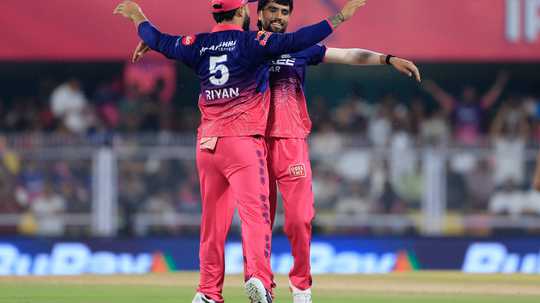
Brijesh Sharma has been a wayfarer for most of his cricketing life so far. No stability, just the next opportunity, tournament after tournament, month after month. It's a story that began in Jammu & Kashmir, a recent hotbed for high-quality quicks. But it has taken several twists and turns before ending up at Rajasthan Royals.
A wildcard pick for IPL 2026, Brijesh has impressed so far with his change of speeds and yorkers, staple products for a T20 bowler. But it hasn't come the conventional way: before the IPL, he had not played a single competitive match.
Son of a labourer in the small, rustic town of Mada, Brijesh made his way up J&K circles, playing U16 and U19 for the state. By the time the U23 level came about, the competition gave him a reality check. Abdul Samad, the J&K batter currently at Lucknow Super Giants, advised Brijesh to train in Delhi to better understand how the world outside works.
@B0$
Deepak Punia, a former Ranji seamer who was once picked by Mumbai Indians, came as a guiding light to Brijesh. Such was the influence that Brijesh would later tell RR that Punia "gave him a new life".
"He came to me around 2021-22," Punia tells Cricbuzz. "He used to play local tennis-ball cricket in J&K. When he came to Delhi, I made him play more professionally, getting him into local tournaments here".
Punia runs an academy called Unique Sports Club on the outskirts of Delhi. "He has great learning powers. Being a fast bowler myself, I taught him from my own experience and skills. He came from a poor family, did not even have shoes to play with. I took care of his stay, meals, and everything else".
At Delhi, Brijesh got the chance to play prestigious local tournaments such as Lala Raghubir Singh Hot Weather tournament and Laxman Dass Chhabra Memorial. "To polish his skills, I made him play the best of the best tournaments in Delhi".
Punia worked a lot on his bowling muscles to increase his pace. "When he first came, he would clock about 125-128kph. Now he has crossed 140. In the IPL practice matches, he touched 145 as well. At the same time, I taught him slower ones, slower bouncers and yorkers too.
"Having played so much tennis-ball cricket, his arm-speed was really fast. And those who have that, it's really difficult to pick their slower ones. I added a back-of-the-hand variation to it too."
However, given Delhi's uber-competitive ecosystem, a breakthrough had to come from elsewhere.
@B1$
In the IPL, Brijesh is registered as a Cricket Association of Bengal player. Two years ago, Brijesh came to West Bengal in search of more playing opportunities. By Brijesh's own admission, it was also a way of playing tennis-ball cricket to earn money.
Punia would deter Brijesh from sticking to the tennis ball too much. "When we started leather ball there, I told him 'We're not playing this (tennis-ball) cricket anymore. There was a risk of injury. Once, he started feeling pain in his elbow, and I completely cut him off".
Punia would himself turn up as an outstation player for the Kidderpore Sporting Club in Kolkata. One of his friends at the club, Debi Prasanna Padhi - also the development committee chairman at CAB - was on the lookout for a bowler for their premier division league.
For context, CAB's club matches are divided into second division and first division, which in turn has the super (or premium division with 11 teams). When available, even top Bengal players like Anustup Majumdar, Abhimanyu Easwaran and Mukesh Kumar turn up there.
That Brijesh got an entry into the top-most division itself was a big first step. "Club matches in Kolkata are very crucial in paving the way for U23 and Ranji selection," MD Azharuddin, who plays for Mohammedan Sporting Club, tells Cricbuzz. Azharuddin would play a role in Brijesh earning his first domestic T20 gig.
Brijesh found support from Padhi, who put him up in one of his flats, which acted as the club's local quarters, sharing the room with two-three other players. Along with Punia, Padhi helped him with meals and stay in Kolkata: "He was struggling at that point, and had some financial troubles too. Mujhse jo ban pada, maine kiya" (I helped him out in whatever ways I could)," Padhi tells Cricbuzz. Padhi ensured Brijesh put his name in various local tournaments, and the accumulating match fees kept helping him out. Meeting different coaches, and playing in a competitive space, Brijesh learnt the value of consistently hitting the same spot.
But the raw talent stood out. "He was different from the start," Azhar says. "Looking at his body structure, you could never understand how he was so quick, or how he had the skills for cutters and slower ones".
@B2$
In a well-established club circuit, Brijesh was in demand for his pace changes, and his name started doing the rounds in the Maidan circles. "In Bengal, T20 format players are quite few," Azhar says. "We hardly get IPL-level players springing out of here".
"We scout and identify players between us," says Azhar. "Player transfers are common to balance out teams". Playing for Mohammedan Sporting, Azhar crossed paths with Brijesh enough to know that his talent deserved to go higher.
@B3$
Having fine-tuned his skills at the local levels, Brijesh's big break came in the Bengal Pro T20 League. State-based leagues have become an easy membrane for IPL scouts to absorb players from. A standout performance can put you firmly in front of the scouts' eyes.
Bought by Sobisco Smashers Malda in the draft, Brijesh picked up 11 wickets in seven games at an economy of 7.7. From there, the RR scouts took over.
Ayan Subhra Mukherjee, assistant coach at Smashers, recalls how Brijesh was on their radar. He had already heard of Brijesh in club cricket, being the coach of Mohammedan Sporting club, and met him at one of the club games.
The Bengal word-of-mouth "scouting" system came into play. Azharuddin, part of the same club, pushed for Brijesh's case, suggesting him as an option.
"In our Bengal Pro T20 draft strategy meeting, we were specifically looking for a white-ball death bowler," Ayan tells Cricbuzz. "I called Azhar and confirmed if he was the same bowler doing well at Kidderpore. We then checked all his stats, videos, and his numbers against us in club cricket". Ayan convinced the team to go for him, and they did.
He explains what made Brijesh stand out: "If you ask him to bowl in one spot, he will. He won't ever complain about getting tired. We made him toil a lot in the nets. He is a very good listener, he observes. If it's helpful, he says 'thank you, bhaiya'. If there's more to add, he plans, stays patient, and evaluates before asking (the coaches).
"We created a great bonding setup across those 20 days (of the T20 league). He would give his bowling inputs (to the team), such as go close or bowl wide of the stumps.
"He would always play to win, not just to compete. He had no other plan. As coaches, we would still have a Plan B and C if things didn't work out, but he would only talk about winning. As a junior, he only had Plan A. If things weren't going to plan, he would step up and say, 'I will do it'. He could deceive batters, and how. Without changing one bit of his arm speed, he could send down a back-of-the-hand that disturbed a lot of good batters in the league."
Azharuddin adds to the praise: "In difficult situations, he would come up to me and ask for bowling. "(Woh bohot tez marta hai) he bowls really fast. Picking a slower one off a fast bowler, only a few can do it well.
At Smashers, Brijesh found a guide in Mukesh Kumar and together they formed a formidable pairing.
"He was always so focused," Gitimoi Basu, one of his seniors at Smashers, tells Cricbuzz. "He didn't come to play the Bengal Pro T20 League, his focus was something else (bigger). It's what IPL scouts look for: swing with the new ball, a pace of 135-140, and proper yorkers and slower balls at the death. We didn't have Mukesh (their marquee player) early in the season (he was playing for India A). Brijesh was our main bowler. And when Mukesh came, they linked up together well.
"We grew up together with Shami - not comparing bowling quality, because he is a legend. But Brijesh's thought process is also very specific, he doesn't interfere in anyone else's work. And if he thinks he can help someone else, he does.
"He hasn't even played Syed Mushtaq Ali Trophy. The scouts must have seen something".
The Pro T20 showings set up an opportunity with the Royals. Ayan recalls talking to Brijesh after the trials. "He said I bowled well, put in the slower ones too. Let's see whether they pick me or not". Even at that point, he was looking at his future assignments, checking up on this year's Bengal T20 draft and retention rules.
Ayan's advice was to just stay honest with himself. "Just like you do, speak less, listen more. Don't worry too much about selection". The coach was hoping to see a slower one with his @L0$ but was happy how he skidded the ball to trap Kartik Sharma lbw.
The Bengal success did not mean that his grind stopped in any way. Between the Bengal T20 League last June and playing local T20 cricket in Kolkata in November, Brijesh squeezed in trips to Delhi, Ghaziabad and J&K to play more cricket. Before he joined the RR camp in Raipur, he was sharpening his skills at the Empress League in Gurgaon, frequented by many IPL regulars.
"He has no fixed spot," says Azhar. "He keeps travelling around, wherever he can play wherever there are matches". Punia says he spends most of his time training in Delhi when not playing elsewhere. "He hardly gets to go home for 10-15 days".
@B4$
"Dada ke bina toh yeh sab ho hi nahi sakta tha" (All of this wouldn't have been possible without Sourav Ganguly Dada", says Padhi. He recalls approaching Ganguly, the CAB President, to help out with Brijesh's paperwork ahead of IPL 2026. By that time, Ganguly had already heard and seen Brijesh's Bengal T20 exploits.
"He had played for the J&K board five years ago. When he came here, he should have taken a no-objective certificate to play in Bengal. The form for this IPL had to be filed from West Bengal. If Dada hadn't supported him, he wouldn't have been able to apply."
Azharuddin claims Ganguly even messaged Padhi to congratulate him on Brijesh's rise. "Another player has emerged in Bengal", Ganguly texted, along with figures and analysis of his bowling.
There's hope among those who helped him that Brijesh's career will continue in Bengal.
"We haven't spoken about it, but he should play from here only," says Azhar. "Dada likes him a lot. After Mukesh and Akash (Deep), he has emerged as the next one from Bengal, so Dada's focus is on him".
"We would try and play from Bengal only," says Punia. "Once he comes back and I speak to him, we will decide what's best".
For now, Brijesh has been steadily doing top work for the Royals. Employed in the middle and end overs, he has been mixing his deliveries up well, maintaining an economy of under nine. His supporters have high hopes for him in the future.
"Our wish is that he goes further up from here, and doesn't just come back after touching this point, going on to play for India," Punia says. "He has bowled well at the death so far. In the Indian team, we hardly have any good death bowlers aside from Jasprit Bumrah".
And while that may be a road far away for now, one thing is certain with Brijesh: the grind never stops.