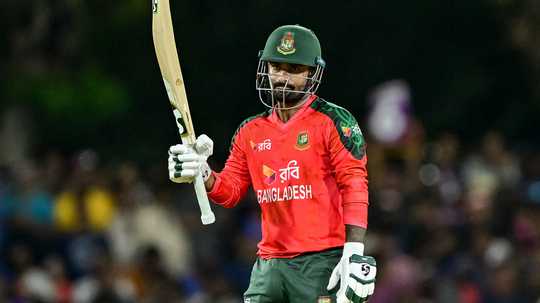
Bangladesh captain Litton Das took a swipe at his team's lower-order batters for failing continuously, stressing that improvement in that area was necessary to succeed in T20 cricket.
New Zealand levelled the series after earning a six-wicket win over the hosts in the series-concluding game at the Sher-e-Bangla National Cricket Stadium on Saturday.
Bangladesh were 88 for 6 at one stage before being bundled out for 102 runs in the rain-curtailed 15-over game. Lower-order failure is not a new issue for Bangladesh's T20 setup, considering the fact the batters from number 8 to 11 have been batting at a strike rate of 127.77 while averaging 17.155 in T20Is over the last year.
"Obviously, if we had scored more runs with the bat, the scenario could have been different. In the first press conference, I said one thing - our lower-order batters have responsibility, and we want input from them with the bat. Today there was an opportunity, but again it was a failure," Das said.
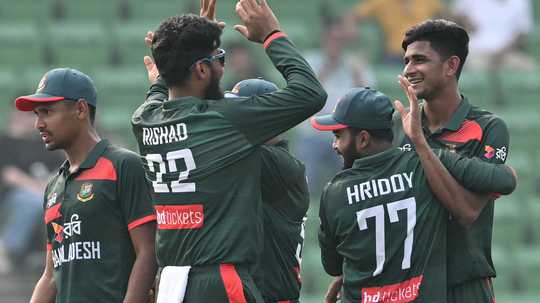
"If you look at their innings, two batters played the key roles as well. So if the break hadn't happened and if I could have cashed in from there to score 60-70 runs, it could have been a different story. But that's cricket. I don't think there's any problem with the six batters we're playing. But at the same time, from players like Rishad [Hosein], Sheikh Mahedi [Hasan], in fact [Tanzim Hasan] Sakib or [Mohammed] Saifuddin - whoever plays - we expect some batting contribution," he added.
"In T20 cricket, we can't go without five bowlers. If I take nine batters, then I'll have to play with three bowlers. If you have any solution, you can give it to us," he said.
"If you play a batter at No. 7, then you can't complete four overs of bowling. Cricket is played with 11 players. Out of them, five bowlers have to complete the 20-over quota. One bowler can't bowl five overs in T20s. So I have to play five bowlers. If there's any player in Bangladesh who you think can bat at seven and bowl four overs, then tell us. We'll find him. Is there anyone else in your eyes? That's what I'm asking you," a scathing Das added.
He also stated that he was hopeful that the lower-order batters will deliver in time and that they were working hard in the nets.
"They've been working on it for a long time. Our batting coaches are spending time behind them. Obviously, you can't change overnight and it's not possible either. But they are trying. I hope by the time the World Cup comes, things will improve at least somewhat," he said.
"Everyone is trying. Even if you watch, you'll see everyone bats till the end in the nets. But batting in the nets and batting in a match are very different things. I hope if they perform in matches, their confidence will build up further," said Litton.
"Rishad, Sheikh Mehedi, Nasum [Ahmed] - they play as specialist spinners. Worldwide, the players who play as spinners and also contribute with the bat - every team has them. Otherwise you need a left-arm wrist-spinner, which some teams have, who can play only as a bowler. But Mehedi can bat, though we need that performance in international cricket. The same goes for Nasum and Rishad," he said, adding that he also expected the pace-bowling all-rounders to perform better with the bat.
Despite their inconsistent performances, notably from openers Saif Hassan and Tanzid Hasan Tamim, the skipper backed the top six batters.
"The six regular batters who are playing are in very good shape. And in T20 cricket, you have to accept that. Also, today's game was totally different - you have to accept that every day you can't start hitting from the first ball. One or two batters will fail. The very good thing was, if mine and Hridoy's partnership had continued, maybe the scenario would have been different. Because you know in T20s, although 11 players play, generally two bowlers and two batters perform," he concluded.