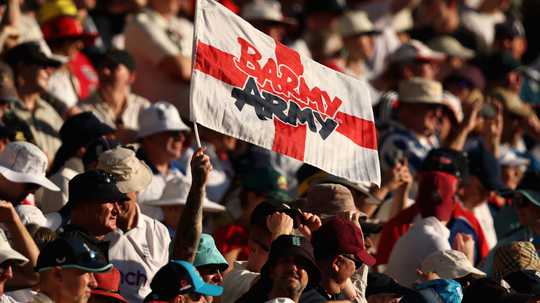
When the England men's football team play in other countries, the locals brace themselves for drunken violence in the streets. When England's men's cricket team tour, the locals look forward to the fun of seeing, hearing and being around the Barmy Army.
Some of England's football fans imagine they're hurling hand grenades in World War II when they're actually throwing glass bottles at statues. Their cricket counterparts seem to be here - or there, or anywhere - for the beer, the bonhomie, and the best of times.
This cultural difference is made curiouser by the fact that many Barmy Army members are also fervent England football supporters. Discuss...
"It's quite hard to explain, but we're a community built on inclusivity, safety, fun, enjoyment, and integrating with the communities we travel to," Adam Canning told Cricbuzz. He should know; he was a Barmy Army member before he became the organisation's commercial and operations director eight years ago.
"We will continue to have an amazing time and continue to support the team through thick and thin. We've tried to maintain those values throughout our growth. There are no negative connotations to our behaviour. It's really well self-policed.
"People who are part of the Barmy Army are really proud of that reputation and will do everything they can to make sure they maintain that reputation worldwide. So if there ever is even a slight inkling that something might be about to happen or there's one individual who might compromise the group, it's managed in-house by the members themselves. That's something we're really proud of."
What about disagreements between members, which must be more likely now given the United Kingdom's increasingly fraught culture wars. Do supporters of left-winger Jeremy Corbyn and far-rightist Nigel Farage get along just because they're wearing identical T-shirts?
"The Barmy Army operates outside of politics, and outside of football rivalries," Canning said. "There's a famous song of ours that members sing if anything gets brought up that's irrelevant and might cause conflict. It goes, "We're only here for the cricket...'
"I think we unite people in a way that other things and other sports can't. Our members share a passion for cricket, England, travel and fun, and nothing can pierce that. So the answer [to the Corbyn-Farage example] is yes.
"You could have a lawyer who's just sold his business for hundreds of millions of pounds sitting next to a painter and decorator with completely different political views. They support different football teams. They come from very different walks of life. But they're Barmy Army members. That's what unites them and that's where they find their common ground. When you see that materialise and manifest itself on tour it's pretty special."
Cannily, Canning refrained from bad-mouthing football supporters in his attempt to explain how they were different from the cricket crowd. Instead he leant into the self-deprecation that comes with the territory of supporting England.
"Cricket's one of those sports where you can have an amazing time and an amazing experience despite the result. You're not influenced necessarily by what's happening on the pitch. Our culture and values have been born on the fact that it was set up in Australia when England were losing heavily, like they do the majority of the time there."
Australia were on their way to a stumps score of 329/4 on the first day of the 1994/95 Ashes series at the Gabba when Dave Peacock, an England fan who had accepted redundancy from his job to pay for his trip, had a bright idea to counter the barbs the Aussie supporters tossed the visiting fans' way as the runs mounted.
Peacock, then 27, led a conga line of six, who danced down a concrete walkway chanting, "We came here with our backpacks, you with ball-and-chains!"
Enraged by the convict jibe, the crowd pelted Peacock and his comrades with verbal abuse and an assortment of missiles, beer included. But when the English fans found their way back to their seats their compatriots heralded them as returning heroes. So they went round again, this time adding to their repertoire of anti-Aussie songs.
Australia won the match but the peacocking Poms won the party. So they rolled it out again at the second Test in Melbourne, where Peacock took to walking the aisles of the MCG holding up an AUS$20 note and promising it to any Australian who could make him and his mates laugh.
"I never lost that AUS$20," Peacock wrote in a LinkedIn post in January last year.
The idea had grown legs by the time the series reached the fourth Test in Adelaide, where Peacock and fellow travellers Paul Burnham and Gareth Evans formerly established what was then called "Mike Atherton's Barmy Army".
England went into that match 2-0 down but won it. The Army's place in England's cricket culture was sealed when Alec Stewart waved Peacock onto the players' balcony to help celebrate the visitors' only success of that series.
Not everyone was amused. Ian Wooldridge, a giant of that age of cricket journalism, wondered in the Daily Mail whether there was "no Australian law under which you get them ejected for breaching the peace of a crowd of 50,000". Peacock checked with the ACB. No such law existed, he was told.
"The Barmy Army was never planned," Peacock wrote. "I was just very lucky; right place, right time. It's as simple as that."
The original, simple plan was for Peacock, Burnham and Evans to sell branded T-shirts to help fund their travels to watch England play. Now their brainchild generates an estimated US$8.5-million in revenue a year, has around 60,000 members on its database and 2.1-million followers on social media, and employs 20 fulltime staff.
"We run a marketing division; we've got a digital marketing element to our business," Canning said. "We've got a full travel operations team, a finance function, a sales function and a couple of other businesses that we run," Canning said.
Among the latter is Joe Root's academy and "another travel business that aims to sell packages to a slightly different market who don't necessarily want to travel with the Barmy Army. And we've also got our own teamware business." Google defines teamware as "collaborative software tools designed to help virtual or remote teams work together".
This slow-burning expansion was, Canning said, "something that needed to happen in order to keep the brand and the business alive. It was a lifestyle business in the 90s and the early 2000s, and the guys who founded it and ran it did a great job in building an amazing brand, an amazing following, an amazing community and something that was really special in the world of cricket.
"And then, five or 10 years ago, through the growth of our digital following, we were able to build a much bigger audience, a much bigger membership and a travel business. The opportunity to take the Barmy Army into travel was a natural next step to make sure that we continue to deliver amazing experiences for our members. It's still a community and a members-first organisation. But in order to grow and make sure that we could sustain our following we had to invest and grow different potential revenue streams."
An interesting measure of that growth was had when the Army's trumpeter of 16 years standing, Billy Cooper, hung up his horn. His last Test was at the Wanderers in January 2020. What happened next? "We advertised," Canning said. "'If you're a trumpeter and you like cricket, let us know...' We got hundreds of applications."
The successful candidate was Simon Finch, who was classically trained at the Guildhall School of Music and Drama in London. He's played Glastonbury and shared a stage with Beyonce and Eric Clapton. Often, when he isn't on cricket duty, Finch is in the orchestra pit at a West End musical. That's serious stuff, and no longer a conga caper.
Canning was interviewed in Cape Town, where he had travelled to plan, in almost granular detail, the visit of an expected 10,000 Barmy Army members to South Africa for England's tour in December and January. He was due to fly to Johannesburg on Wednesday to do the same.
But it isn't all about seamless growth. The Covid-19 pandemic "nearly led to us going out of business. We just managed to keep our heads above water. We weren't able to travel or watch live sport. But we knew how important shared experiences were for our community. We wanted to keep engaged with people and give them some sort of fun content. So we started Barmy Army TV [a YouTube channel]."
That's part of what caters to "a really diverse community. We've got junior members and 35% of our membership is female. When we go overseas, we've got a significant female contingent travelling with us for that sense of belonging and safety. It's not just what some people around the world envisage, which is a misrepresentation of 50-year-old men who love drinking beer. There are some, clearly, but there are also families, couples, and solo travellers."
That said, what does the Barmy Army do for a beer in places like Pakistan, Bangladesh and Ahmedabad, where alcohol is restricted?
"Sometimes you have to negotiate behind closed doors to get a crate of beer into a hotel in an unofficial room or somewhere in a basement," Canning said. "But people who travel the world understand that different cultures have different expectations on behaviour. And they are respectful and will abide by the rules and regulations and ingratiate themselves with the locals."
They won't, Canning didn't have to say, throw bottles at statues.