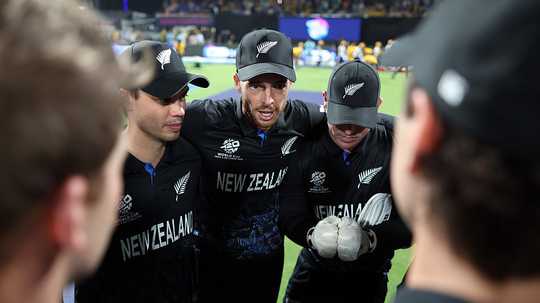
There was something curious about what Mitchell Santner said in Thiruvananthapuram a little over a month ago.
New Zealand had just lost a five-match T20I series to India 4-1. The defeats were not particularly close. India had made 238 and 271 batting first, and chased targets of 209 and 154 with plenty of overs to spare. For long stretches in the series, the visitors had looked a step behind, out-batted, out-bowled and often overwhelmed by the tempo India managed to sustain.
And yet, Santner described it as "a really good series for us."
"Obviously the results haven't gone our way," the New Zealand captain added at the post-match presentation, "but there are learnings from every single game."
The words sounded odd at the time. Perhaps the sort of thing you say after a difficult tour. New Zealand were so far behind in that series that their only win came in a dead rubber in Vizag, when Suryakumar Yadav experimented with six batters and five bowlers to "challenge" his side.
What Santner meant by those words has become a little clearer now.
Just over a month after that series ended, New Zealand find themselves across from India again. Only this time it is not a bilateral contest stretching over five evenings; it is a World Cup final.
"I think in terms of planning and execution it was a great series," Santner said again on the eve of the final. "We were challenged at times, well, a lot of times throughout that series. But again, you kind of build on what works, what doesn't work, and you kind of take that information going forward.
"I think guys will take obviously good conversations from that series into this game already. And again, we learn from that and try to put India under pressure for a long time. I guess a World Cup final is a little bit different to a series."
Some of the learnings began to show soon after the series. Finn Allen arrived for the final match of that series in Thiruvananthapuram and the tempo at the top changed. Through this T20 World Cup, Allen and Tim Seifert have carried that momentum and learnings, building quick opening partnerships to do to others what India had done to New Zealand. The pair have already added 463 runs together in this edition so far, the highest aggregate for an opening pair in a single T20 World Cup edition.
Selections reflected a pivot too. Ish Sodhi, New Zealand's most attacking spinner and who played all the five matches of that bilateral series, was picked for World Cup matches in Sri Lanka but held back on flatter surfaces in India, where extravagant turn was unlikely to be on offer. And when Michael Bracewell was ruled out injured, New Zealand resisted the safer, more experienced options and instead brought in Cole McConchie, a relatively unknown offspinning allrounder, first as a travelling reserve and then into the XI.
There was also a shift in how New Zealand looked at T20Is in India, with Santner speaking about minimising the damage in expensive overs, keeping teams to around 220 on a 250 pitch, and treating 220 as a total their batting could chase.
Their strengths, however, remained intact. New Zealand arrived at this World Cup as the second-best side against spin in the current cycle and largely played like it.
The learnings Santner spoke about did not change the result immediately, but they shaped how New Zealand moved through the T20 World Cup that followed. For them, this final must feel like a return to the question that defined that bilateral series, a story arc seeking its conclusion. But across the other dressing room too are a couple of individual stories waiting for their own ending.
Abhishek Sharma and Varun Chakaravarthy walked into this T20 World Cup as the No.1 batter and bowler in the ICC rankings. They still hold those positions despite what has been a relatively quiet tournament for both by their standards. Which says a lot about just how good the last couple of years had been for them.
Abhishek's @L0$ began with his debut in Harare in mid-2024 and gathered pace quickly. India's opening plans at the time revolved around Shubman Gill and Yashasvi Jaiswal, but Abhishek forced the selectors to pivot with a kind of batting that demanded attention. Runs followed across continents, in India, Australia, South Africa and the UAE. The sixes came just as easily. Within a year he had become one of the most destructive Powerplay batters in the format.
Then, just before the World Cup, illness intervened. A stomach infection required hospitalisation and IV drips. The immediate concern was recovery, but the after-effects lingered longer than expected. Abhishek, who played the opening match against the USA with high fever, went on to lose muscle and mass. It's a small detail perhaps, but one that matters for a batter who's barely heavier than an average university student and whose game depends heavily on a powerful @L1$.
Through the tournament, he has increasingly looked close to his old self without quite reaching it. Off-spinners have been able to tie him down more often than they used to. Shots that once cleared the ropes have sometimes found fielders in the deep. For someone who spent two years making the extraordinary feel routine, the World Cup has been unusually quiet.
Varun's journey goes back longer in time, but carries a similar sense of unfinished business. His first T20 World Cup appearance came in 2021, when he was picked as India's mystery spinner. On UAE surfaces that were expected to help him, he finished the tournament wicketless in three matches. Two World Cups passed but an international match wouldn't come his way.
What followed was @L2$. Varun gradually moved away from relying purely on sidespin and instead switched to overspin, trying to beat batters with bounce rather than lateral movement on flat T20 wickets. The googly and the legbreak both came out scrambled, and the impact was almost immediate. He finished as the second-highest wicket-taker in IPL 2024 and carried that form through domestic tournaments before returning to India's T20I side.
This T20 World Cup was, then, meant to confirm that comeback. Instead, it has been a huge downer. Batters have increasingly played him with ease, staying back and seeing through his variations that had made him so effective over the last two years.
"There is nothing to worry about," Suryakumar said at the pre-final press conference. "We won the match [semifinal against England, when Varun conceded 1/64]. "It's a team sport... There are 11 players. Everyone's day won't be good. Everyone can go up and down. The rest are there to cover. I am not worried about that. He is the world's number one bowler. He is a world-class bowler and knows how to win matches. He will definitely do that."
Which brings several threads to the same point, looking for a closure.
A much-improved New Zealand side, that spent a bilateral series learning how far behind it might be, now faces the same opponent again, with a trophy on the line. A young opener, searching for the sixes that made him the most destructive Powerplay batter over the last couple of years, arrives with his reputation on the line. And a mystery spinner, who rebuilt himself after one difficult World Cup, arrives with his redemption on the line.
By the end of Sunday night, at least one of these stories may look a little different.